
A Global CMMI Level 3 Company
Supabase Development Company

Supabase Development Experts

Supabase
Development Company

Build production-grade applications with Supabase, backed by engineers who know Postgres.

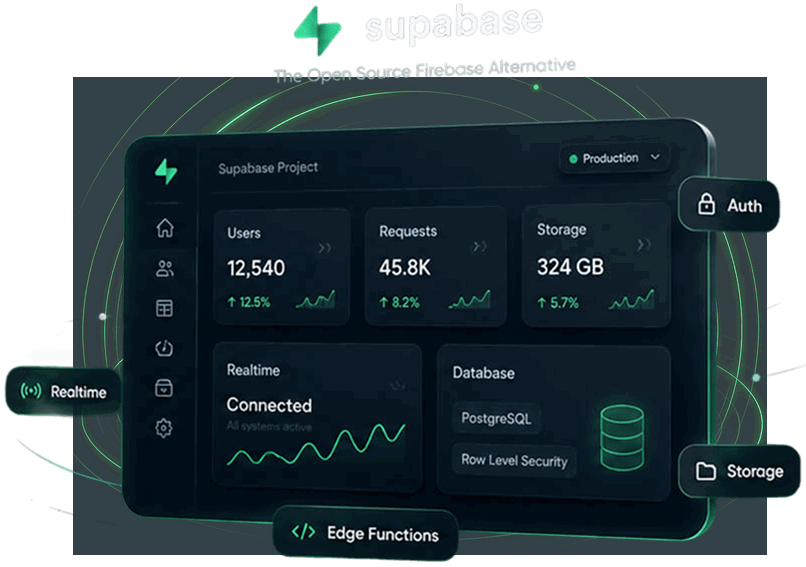
As a Supabase development company in USA, we help product teams ship real backends, not prototypes. Our Supabase development services cover schema design, Row Level Security, auth, realtime, storage and Edge Functions. The Supabase developers on our team build on Postgres properly, so your data model holds up as you scale. And where Supabase is the wrong fit, we tell you and build the hybrid your product actually needs.

Supabase development company
Secure by Design

Auth, RLS, and best security practices

Faster Development

Launch features and products, quicker

Scalable Backend

PostgreSQL power with modern serverless

AI Ready

Vector support, Edge Functions & more

Flexible Stack

Works with Next.js, React, Laravel, Node.js & more

Why Business Should Invest In Supabase Development?

Most teams do not struggle with Supabase because the platform is limited. They struggle because it was set up like a prototype and then shipped to production. Tables without policies, a service_role key in the client, no connection pooling, no migration history. Custom Supabase development means the Postgres layer is designed deliberately from the start, so the backend that carries your first hundred users is the same one that carries your first hundred thousand.

Supabase publishes every table through PostgREST the moment it exists. Without Row Level Security enabled and policies written per table, any client holding the public anon key can read data it should never see. Our Supabase engineers treat policy coverage as a build requirement, not a hardening step at the end.
A schema built to demo quickly becomes the thing you cannot change later. Missing foreign keys, no indexes on filtered columns, tenancy bolted on afterwards. Custom Supabase development front-loads the data model, because remodelling a live Postgres database under paying customers is the most expensive work there is.
Postgres has a hard connection ceiling, and serverless functions open connections fast. Teams discover this during a traffic spike, not before. When you hire Supabase developers who have run this in production, Supavisor pooling, query tuning and read replicas are planned upfront instead of diagnosed at 2am.
GoTrue gives you sign-up in minutes. What it does not give you is a role model, tenant scoping, session handling across refresh, or a safe way to run privileged operations. Our Supabase development experts design the auth layer around your actual permission rules, then test that it holds.
Not everything needs a live subscription, and Edge Functions are the wrong place for long-running or heavy processing. Teams push work there because it is convenient, then fight cold starts and timeouts. A professional Supabase development company tells you which workloads belong elsewhere before you build them.
Supabase is open source and self-hostable, which is only true in practice if the build respects it. Standard Postgres, versioned migrations, no undocumented dashboard-only configuration. We build so you can move to your own infrastructure if the business ever requires it.

Our Supabase Engineering Experience, Validated In Numbers

50+
Supabase projects delivered end to end
30+
Postgres and Supabase developers on staff
20+
Firebase to Supabase migrations completed
15+
Years building production systems on PostgreSQL
10+
Industries served, from SaaS to fintech to marketplaces
10+
Supabase deployments running in production today

Our Complete Suite Of Supabase Development Services for Modern Businesses

As a trusted Supabase development services company in USA, Owebest covers the full lifecycle, from the first architecture conversation to the database still running three years later. Some teams need an MVP shipped in weeks. Others need a Firebase migration handled without downtime, or a Postgres schema rescued before it buckles. What separates us from most Supabase development services providers is that our Supabase developers will tell you which of the fifteen areas below your product actually needs.

​

1. Supabase Consulting and Architecture Review

Our Supabase consulting services start before anything gets built. We review your schema, your policy coverage and your intended traffic pattern, then deliver a written Supabase architecture review covering what holds and what breaks, including whether Supabase is the right platform at all. Teams already mid-build use this to find tenancy gaps before security diligence does.

​

2. Custom Supabase Application Development

As a Supabase company in USA delivering custom Supabase development services, we own full Supabase app development end to end. Schema, policies, auth, realtime, storage, Edge Functions and frontend integration, designed together rather than bolted on in sequence. Teams who hire Supabase developers from us get a data model shaped around the product, not around the dashboard.

​

3. Supabase MVP Development

Supabase MVP development should get you to a working product quickly without writing code your team throws away three months later. We use Supabase exactly where it accelerates you, keep migrations versioned from day one, and avoid the shortcuts that turn version two into a rewrite. The MVP that raises your round stays your foundation.

​

4. Supabase RAG Development

Supabase RAG development uses pgvector inside your existing Postgres database, so embeddings live beside the relational data they describe. No separate vector store to sync, secure or pay for. We handle chunking strategy, embedding pipelines, index selection and the retrieval quality testing that decides whether the answers your users actually see are useful.

​

5. Supabase AI Application Development

As a Supabase company with AI engineers, we handle Supabase AI application development by building AI into products rather than beside them. Model calls run through Edge Functions, prompts and outputs are stored and versioned in Postgres, and Row Level Security governs which user sees which result. An AI-powered Supabase development company makes AI queryable.

​

6. Supabase Backend Development

Supabase backend development as a deliberate build: business logic placement, database functions and triggers, background jobs with pg_cron, third-party service integration and the API surface your clients consume. We decide what belongs in Postgres, what belongs in an Edge Function and what needs a dedicated worker running outside Supabase entirely.

​

7. Supabase Database and Postgres Engineering

Supabase database design is the work most agencies skip. Normalisation, constraints, foreign keys, index strategy, query plan analysis, partitioning and migration discipline. Supabase is PostgreSQL, and every ceiling you hit is a Postgres ceiling. Teams who hire Supabase engineers from us are hiring Postgres engineers first, which is the entire difference.

​

8. Supabase Authentication and Row Level Security

Supabase auth development covers GoTrue configuration, social and enterprise providers, session handling, role modelling and tenant scoping, then Row Level Security policies written per table and verified. We test as an untrusted client holding only the public anon key and attempt cross-tenant reads on every exposed table. Coverage gets proven, not assumed.

​

9. Supabase Realtime Development

Supabase Realtime development is worth it where live data genuinely improves the product: collaborative editing, presence indicators, dashboards, chat and order tracking. We scope subscriptions deliberately, because Realtime respects Row Level Security and an over-broad channel is both a performance cost and a data exposure risk. Where polling wins, we say so.

​

10. Supabase Storage Implementation

Supabase Storage implementation covers bucket structure, storage policies tied to the same auth model as your tables, signed URLs, upload limits and image transformation. Storage is where permission models usually leak, because access rules get written carefully for the database and then forgotten entirely for the files sitting right beside it.

​

11. Supabase Edge Functions and API Integration

Supabase API development and Deno-based Edge Functions for webhooks, payment flows, scheduled work and third-party integrations, plus the REST and GraphQL surfaces your clients call. We keep heavy or long-running processing out of Edge Functions and move it to dedicated workers, so you avoid a quarter spent fighting cold starts and timeouts.

​

12. Firebase to Supabase Migration

Firestore documents remodelled into relational tables, security rules redesigned as RLS policies, Firebase Auth users re-provisioned into GoTrue, Cloud Functions rewritten as Edge Functions. If you are still weighing Firebase vs Supabase, we will tell you honestly. Our Firebase to Supabase migration services work in phases with both systems live, because document stores do not translate cleanly.

​

13. Self-Hosted Supabase Deployment

Self-hosted Supabase deployment runs the full stack on your own infrastructure or private cloud, for teams with data residency requirements, compliance obligations or a strategic objection to lock-in. Postgres, GoTrue, PostgREST, Realtime, Storage and Kong deployed and documented, with the upgrade, patching and backup responsibilities you take on stated clearly upfront.

​

14. Supabase Performance and Scaling

Supabase performance optimization starts from slow query identification, index correction, Supavisor connection pooling, read replicas, caching strategy and realtime load management. Most Supabase performance problems are Postgres problems wearing a Supabase label, so we work from real query plans and actual traffic data rather than guessing at configuration and hoping.

​

15. Supabase Support and Maintenance

Our Supabase support and maintenance services in USA continue after launch: version upgrades, migration review, policy audits as features ship, backup and PITR verification, monitoring and incident response. New tables get added by every team eventually, and each one is a table that might have shipped without a policy attached.

Our Supabase consulting services start before anything gets built. We review your schema, your policy coverage and your intended traffic pattern, then deliver a written Supabase architecture review covering what holds and what breaks, including whether Supabase is the right platform at all. Teams already mid-build use this to find tenancy gaps before security diligence does.
As a Supabase company in USA delivering custom Supabase development services, we own full Supabase app development end to end. Schema, policies, auth, realtime, storage, Edge Functions and frontend integration, designed together rather than bolted on in sequence. Teams who hire Supabase developers from us get a data model shaped around the product, not around the dashboard.
Supabase MMVP development should get you to a working product quickly without writing code your team throws away three months later. We use Supabase exactly where it accelerates you, keep migrations versioned from day one, and avoid the shortcuts that turn version two into a rewrite. The MVP that raises your round stays your foundation.
Supabase RAG development uses pgvector inside your existing Postgres database, so embeddings live beside the relational data they describe. No separate vector store to sync, secure or pay for. We handle chunking strategy, embedding pipelines, index selection and the retrieval quality testing that decides whether the answers your users actually see are useful.
As a Supabase company with AI engineers, we handle Supabase AI application development by building AI into products rather than beside them. Model calls run through Edge Functions, prompts and outputs are stored and versioned in Postgres, and Row Level Security governs which user sees which result. An AI-powered Supabase development company makes AI queryable.
Supabase backend development as a deliberate build: business logic placement, database functions and triggers, background jobs with pg_cron, third-party service integration and the API surface your clients consume. We decide what belongs in Postgres, what belongs in an Edge Function and what needs a dedicated worker running outside Supabase entirely.
Supabase database design is the work most agencies skip. Normalisation, constraints, foreign keys, index strategy, query plan analysis, partitioning and migration discipline. Supabase is PostgreSQL, and every ceiling you hit is a Postgres ceiling. Teams who hire Supabase engineers from us are hiring Postgres engineers first, which is the entire difference.
Supabase auth development covers GoTrue configuration, social and enterprise providers, session handling, role modelling and tenant scoping, then Row Level Security policies written per table and verified. We test as an untrusted client holding only the public anon key and attempt cross-tenant reads on every exposed table. Coverage gets proven, not assumed.
Supabase Realtime development is worth it where live data genuinely improves the product: collaborative editing, presence indicators, dashboards, chat and order tracking. We scope subscriptions deliberately, because Realtime respects Row Level Security and an over-broad channel is both a performance cost and a data exposure risk. Where polling wins, we say so.
Supabase Storage implementation covers bucket structure, storage policies tied to the same auth model as your tables, signed URLs, upload limits and image transformation. Storage is where permission models usually leak, because access rules get written carefully for the database and then forgotten entirely for the files sitting right beside it.
Supabase API development and Deno-based Edge Functions for webhooks, payment flows, scheduled work and third-party integrations, plus the REST and GraphQL surfaces your clients call. We keep heavy or long-running processing out of Edge Functions and move it to dedicated workers, so you avoid a quarter spent fighting cold starts and timeouts.
Firestore documents remodelled into relational tables, security rules redesigned as RLS policies, Firebase Auth users re-provisioned into GoTrue, Cloud Functions rewritten as Edge Functions. If you are still weighing Firebase vs Supabase, we will tell you honestly. Our Firebase to Supabase migration services work in phases with both systems live, because document stores do not translate cleanly.
Self-hosted Supabase deployment runs the full stack on your own infrastructure or private cloud, for teams with data residency requirements, compliance obligations or a strategic objection to lock-in. Postgres, GoTrue, PostgREST, Realtime, Storage and Kong deployed and documented, with the upgrade, patching and backup responsibilities you take on stated clearly upfront.
Supabase performance optimization starts from slow query identification, index correction, Supavisor connection pooling, read replicas, caching strategy and realtime load management. Most Supabase performance problems are Postgres problems wearing a Supabase label, so we work from real query plans and actual traffic data rather than guessing at configuration and hoping.
Our Supabase support and maintenance services in USA continue after launch: version upgrades, migration review, policy audits as features ship, backup and PITR verification, monitoring and incident response. New tables get added by every team eventually, and each one is a table that might have shipped without a policy attached.
Supabasecta1
Work With Supabase Engineers Who Understand Enterprise Challenges

Multi-tenant data isolation? Row Level Security audited for compliance? Data residency requirements that rule out managed hosting? You need custom Supabase development services built around these constraints, not a dashboard configured quickly and hardened later.

Schedule Consultation With Supabase Expert

Why Supabase Projects Stall, And How We Build On A Powerful PostgreSQL Foundation

Building on Supabase comes with engineering realities the dashboard was never designed to surface. From schema decisions made in week one to connection ceilings discovered under load, every challenge your project faces requires a deliberate response rather than a configuration change. Here is how Owebest, a leading Supabase development company in USA, addresses the most critical problems teams encounter across SaaS, fintech, healthcare and marketplace products, and why our Supabase development services start with PostgreSQL rather than the platform sitting on top of it.

1. Schema Decisions That Cannot Be Undone Later

Supabase hands you a live PostgreSQL database in minutes, which means the schema that was meant to demo an idea often becomes the schema carrying paying customers. Missing foreign keys, no indexes on filtered columns, and tenancy bolted on after launch are the three that hurt most. Our Supabase database design work front-loads the data model, because remodelling a production Postgres database with live traffic is the most expensive work in any build.

How We Address It:

  • Model entities, relationships and constraints before feature work begins
  • Choose the multi-tenancy pattern explicitly, shared table or schema-per-tenant, and document why
  • Keep every change in versioned migrations from the first commit, never dashboard-only edits
  • Add indexes based on actual query patterns, then verify with query plan analysis
  • Enforce referential integrity in the database rather than in application code

2. Row Level Security Coverage That Was Never Verified

PostgREST publishes every table the moment it exists, so a table without a policy is a table the public anon key can read. Teams enable Row Level Security on the tables they remember, and the gaps surface during security diligence or a breach rather than during testing. Our Supabase authentication and RLS work treats policy coverage as a build requirement that gets proven, not a hardening task scheduled for later.

How We Address It:

  • Write RLS policies per table as part of the feature, never as a cleanup pass
  • Test as an untrusted client holding only the public anon key, not the service_role key
  • Attempt cross-tenant reads against every exposed table until nothing comes back
  • Keep the service_role key server-side only, never shipped to a browser or mobile client
  • Re-audit policy coverage every time a new table ships

3. Connection Limits Discovered During A Traffic Spike

PostgreSQL has a hard connection ceiling, and serverless functions open connections far faster than most teams expect. The failure arrives during your best traffic day and looks like an application bug rather than a database one. Supabase performance optimization here is Postgres work, so our Supabase engineers plan pooling and replica strategy before load arrives instead of diagnosing it during an incident.

How We Address It:

  • Configure Supavisor connection pooling for your actual access pattern, transaction or session mode
  • Review connection behaviour function by function rather than assuming defaults are safe
  • Identify slow queries from real query plans and fix the index strategy behind them
  • Plan read replicas against projected load, not after the first outage
  • Load test against production-shaped data volumes before launch

4. Workloads Placed Where They Do Not Belong

Edge Functions are convenient, so heavy processing, long-running jobs and batch work end up inside them. The team then spends a quarter fighting cold starts, execution timeouts and retry logic that should never have been necessary. Correct Supabase backend development is mostly placement decisions: knowing which work belongs in Postgres, which belongs in Deno, and which belongs somewhere else entirely.

How We Address It:

  • Keep Edge Functions to short, request-scoped logic such as webhooks and payment flows
  • Move scheduled and recurring work into pg_cron inside the database
  • Push sustained, heavy or long-running processing to a dedicated worker outside Supabase
  • Scope Realtime subscriptions narrowly, since an over-broad channel costs both performance and privacy
  • Use database functions and triggers where logic genuinely belongs beside the data

5. Integration With Systems Supabase Was Never Meant To Replace

Enterprise products rarely start empty. There is an existing Laravel or Node service, an identity provider, an ERP, a data warehouse. Teams attempt to move all of it onto Supabase and break things that were working perfectly well. Custom Supabase development services should treat Supabase as one component in your architecture, not a replacement for everything you have already built and paid for.

How We Address It:

  • Keep existing services where they are genuinely stronger than a Supabase equivalent
  • Design the integration boundary deliberately rather than migrating by default
  • Connect enterprise identity providers to Supabase Auth instead of rebuilding user management
  • Build API layers with Edge Functions where systems need to exchange data
  • Recommend against migration outright when the business case does not hold

6. Compliance, Data Residency And Lock-In Exposure

Managed hosting works until a customer contract specifies data residency, an auditor asks where data physically sits, or leadership asks what happens if pricing changes. Supabase is open source and self-hostable, but that only holds in practice if the build respects it. Self-hosted Supabase deployment is a real option for teams who need it, provided nothing critical lives only in the dashboard.

How We Address It:

  • Build on standard PostgreSQL features so the database stays portable
  • Keep all configuration in versioned migrations and infrastructure as code
  • Deploy the full stack, Postgres, GoTrue, PostgREST, Realtime, Storage and Kong, on your own infrastructure when required
  • Verify backup and point-in-time recovery rather than assuming they are configured
  • State the upgrade, patching and monitoring responsibilities you take on with self-hosting, upfront
Supabase hands you a live PostgreSQL database in minutes, which means the schema that was meant to demo an idea often becomes the schema carrying paying customers. Missing foreign keys, no indexes on filtered columns, and tenancy bolted on after launch are the three that hurt most. Our Supabase database design work front-loads the data model, because remodelling a production Postgres database with live traffic is the most expensive work in any build.
PostgREST publishes every table the moment it exists, so a table without a policy is a table the public anon key can read. Teams enable Row Level Security on the tables they remember, and the gaps surface during security diligence or a breach rather than during testing. Our Supabase authentication and RLS work treats policy coverage as a build requirement that gets proven, not a hardening task scheduled for later.
PostgreSQL has a hard connection ceiling, and serverless functions open connections far faster than most teams expect. The failure arrives during your best traffic day and looks like an application bug rather than a database one. Supabase performance optimization here is Postgres work, so our Supabase engineers plan pooling and replica strategy before load arrives instead of diagnosing it during an incident.
Edge Functions are convenient, so heavy processing, long-running jobs and batch work end up inside them. The team then spends a quarter fighting cold starts, execution timeouts and retry logic that should never have been necessary. Correct Supabase backend development is mostly placement decisions: knowing which work belongs in Postgres, which belongs in Deno, and which belongs somewhere else entirely.
Enterprise products rarely start empty. There is an existing Laravel or Node service, an identity provider, an ERP, a data warehouse. Teams attempt to move all of it onto Supabase and break things that were working perfectly well. Custom Supabase development services should treat Supabase as one component in your architecture, not a replacement for everything you have already built and paid for.
Managed hosting works until a customer contract specifies data residency, an auditor asks where data physically sits, or leadership asks what happens if pricing changes. Supabase is open source and self-hostable, but that only holds in practice if the build respects it. Self-hosted Supabase deployment is a real option for teams who need it, provided nothing critical lives only in the dashboard.

Supabase Development Services Tailored for Every Industry We Serve

As a USA-based Supabase development company, we build industry-specific backends around the constraints each sector actually imposes. A healthcare product needs audit trails and residency controls. A B2B SaaS platform needs tenant isolation that survives enterprise diligence. Our extensive Supabase expertise means the schema, the Row Level Security model and the hosting decision get shaped by your industry from the start, not retrofitted after your first compliance review or enterprise security questionnaire arrives.

​

Healthcare and Digital Health

Patient data carries obligations that a default Supabase setup does not meet. We build Supabase applications with strict Row Level Security separating patient, clinician and administrator access, full audit logging of every read and write, and encrypted storage for records and imaging. Where regulation demands it, self-hosted Supabase deployment keeps data inside your own infrastructure and jurisdiction.

​

Finance and Fintech

Financial products need correctness before speed. Our custom Supabase development uses Postgres transactions, constraints and triggers to enforce ledger integrity at the database level rather than trusting application code. Point-in-time recovery, immutable audit tables and strict service_role key handling are built in, because in fintech a data inconsistency is a reconciliation problem, not a bug ticket.

​

B2B SaaS and Vertical Software

Multi-tenancy is the decision that defines a SaaS product development, and reversing it later is painful. We choose shared-table or schema-per-tenant deliberately, then prove isolation by attempting cross-tenant reads with the anon key. As experts in Supabase development, we build the tenancy, roles and billing model together so enterprise security reviews do not stall your deals.

​

Real Estate and PropTech

Property platforms live on search, geography and media. We use PostGIS for location queries, Supabase Storage with signed URLs for listing images and documents, and Realtime for availability and offer status. Our Supabase development solutions keep agent, landlord and buyer permissions cleanly separated, so no role sees pricing or contact data it should not.

​

Marketplaces and Multi-Sided Platforms

Buyers, sellers and admins each need a different view of the same tables, which is exactly what Row Level Security is for. We build Supabase applications where policies enforce those boundaries at the database, handle payment webhooks through Edge Functions, and use Realtime for order status. Marketplace bugs tend to be permission bugs.

​

E-commerce and Retail

Catalogue, inventory, orders and customers modelled relationally so reporting does not require a separate warehouse on day one. Our Supabase agency work covers cart and checkout flows, Stripe integration through Edge Functions, and inventory accuracy under concurrent purchases, where Postgres row locking does work that a document database genuinely struggles to do correctly.

​

Logistics and Supply Chain

Tracking is a realtime problem sitting on a relational one. We combine Supabase Realtime for live shipment and driver status with PostGIS for routing and geofencing, and pg_cron for scheduled reconciliation. Custom Supabase development solutions here mean carrier, warehouse and customer each see live data scoped strictly to their own consignments.

​

EdTech and E-learning

Learners, instructors and institutions need separate access to shared course data, with progress tracking that stays accurate at scale. We build the enrolment and permissions model in Postgres, handle video and material delivery through Storage policies, and use Realtime for live classroom features. Institutional buyers get SSO connected to Supabase Auth.

​

AI Products and Data-Intensive Apps

As an AI Supabase development company, we build retrieval and AI features on pgvector inside your existing database, so embeddings sit beside the relational records they describe. Model calls run through Edge Functions, outputs are versioned in Postgres, and Row Level Security governs which user sees which generated result. No separate vector store.

​

Media, Publishing and Content Platforms

Content platforms need fast reads, editorial workflow and reliable media handling. We model publishing states and permissions in Postgres, deliver assets through Supabase Storage with transformation, and tune read performance with indexes and read replicas. Build smarter applications using Supabase where the editorial team ships content without an engineer in the loop.

​

Travel and Hospitality

Availability, booking and pricing are concurrency problems, and Postgres handles them properly with transactions and constraints. We prevent double-booking at the database level rather than in application logic, use Realtime for live availability, and keep property, guest and operator data separated by policy. Supabase solutions providers in USA rarely start here, but they should.

​

Startups and Funded Product Teams

Speed without technical debt you inherit at Series A. We ship the MVP on Supabase with versioned migrations, real policy coverage and a schema built to grow, so diligence does not surface a backend that has to be rewritten. Teams needing Supabase developers for hire can embed our engineers directly alongside their own.

Applications We Build With Supabase Development Services

We build production applications on Supabase across SaaS, marketplaces, mobile, AI and internal systems. Every product type below has been shipped by our team, and every one carries a decision that has to be right early: how tenancy is modelled, where permissions live, what the client is trusted with. We ranked among best Supabase development agencies for production-grade backends settle those first. Here is what we build and what each one demands.

Our Proven Supabase Development Process, From Discovery to Deployment

At Owebest, the Supabase development process runs in a deliberate order: the decisions you cannot reverse come first, the convenient ones come later. Schema before features. Policies before launch. That order is the opposite of how the platform encourages teams to work, and it is the reason our builds hold under real traffic. From a six-week MVP to an enterprise migration across three quarters, our Supabase development company in USA works the same way.

Step 1: Discovery and Supabase Fit Assessment

We start with requirements, expected traffic, your existing stack and any compliance constraints, then give you the honest answer on whether Supabase fits. Sometimes it does not, and sometimes the right result is a hybrid that keeps your current services where they are stronger. Our Supabase developers would rather tell you that now than bill you for a migration you regret.

Entities, relationships, constraints, indexes and the multi-tenancy decision, settled before feature work begins. Building applications using Supabase is fast, which is exactly why this step gets skipped, and remodelling a live Postgres database under paying customers is the most expensive work in any Supabase development lifecycle. We version every change from the first migration.

Auth provider strategy, role modelling, tenant scoping, Row Level Security policy design, storage policies and key handling all get designed here, not bolted on before launch. The public anon key ships to your clients and the service_role key never leaves the server. Treating access control as an architecture decision rather than a hardening task is what separates production builds from prototypes.

We decide what belongs in Postgres, what belongs in a Deno Edge Function, what runs on pg_cron and what needs a dedicated worker outside Supabase entirely. Building apps with Supabase goes wrong most often here, so Realtime subscriptions get scoped, Supavisor pooling gets configured for your access pattern, and integration boundaries get drawn deliberately.

Agile Supabase development in two-week sprints, with working software at the end of each one rather than a status update. Versioned migrations, separate dev, staging and production environments, and code review on every change. Our Supabase app development work covers frontend integration alongside the backend, so you see progress continuously.

We test policy coverage as an untrusted client holding only the anon key, attempting cross-tenant reads on every exposed table until nothing comes back. Load testing runs against production-shaped data volumes, backups and point-in-time recovery get verified rather than assumed, and release is phased. Nothing ships because the feature works in staging.

After launch we track query performance from real plans, audit policy coverage every time a new table ships, handle version upgrades and respond to incidents. Teams who hire Supabase developers from us for this phase get a dedicated Supabase development team that already knows the schema, rather than someone reading it for the first time during an outage.

Tools and Technology Stack Powering Our Supabase Development Solutions

Owebest stands out among leading Supabase development companies because we build on the components Supabase actually runs, not a generic logo grid. PostgREST exposes your tables. GoTrue handles identity. Supavisor manages connections. Knowing what sits under the dashboard is what lets our Supabase developers debug a problem at the layer it originates rather than guessing at settings. Below is the full stack we work across, from Postgres extensions to frontend frameworks and deployment tooling.

PostgreSQL
PostgREST
GoTrue (Supabase Auth)
Realtime (Phoenix/Elixir)
Storage
Edge Functions (Deno)
Supavisor
Kong API Gateway
Supabase CLI
Supabase Studio
pgvector
PostGIS
pg_cron
pgTAP
pg_net
pgcrypto
pg_stat_statements
uuid-ossp
pgjwt
pgsodium
TypeScript
JavaScript
SQL
PL/pgSQL
Deno
Node.js
Python
Dart
Swift
Kotlin
Next.js
React
Vue.js
Nuxt
SvelteKit
Angular
Remix
Astro
Tailwind CSS
React Native
Flutter
Expo
Swift (iOS)
Kotlin (Android)
Ionic
supabase-js
supabase-py
supabase-flutter
supabase-swift
supabase-kt
supabase-csharp
pgvector
OpenAI
Anthropic Claude
LangChain
LlamaIndex
Hugging Face
Vercel AI SDK
Ollama
Supabase Auth
Google OAuth
GitHub OAuth
Apple Sign In
Microsoft Entra ID
Okta
Auth0
SAML 2.0
Magic Links
Multi-Factor Authentication
Stripe
Paddle
Razorpay
PayPal
Lemon Squeezy
Supabase Cloud
Vercel
Netlify
AWS
Google Cloud
Microsoft Azure
DigitalOcean
Fly.io
Cloudflare Workers
Railway
Docker
Docker Compose
Kubernetes
Terraform
Nginx
Traefik
GitHub Actions
GitLab CI
Logflare
Grafana
Prometheus
Sentry
Datadog
Better Stack
pg_stat_statements
pgTAP
Vitest
Jest
Playwright
Cypress
Supabase CLI local development
k6
Resend
SendGrid
Twilio
Zapier
n8n
Make
Algolia
Cloudinary
Webhooks
Supabasecta1
Your Product Demands Custom Supabase Solutions. Default Configurations Are Not Enough!

With Postgres engineers, verified Row Level Security policies and SOC 2 ready delivery practices, we build Supabase backends that survive enterprise security reviews and real production traffic.

Consult Our Supabase Specialists

Supabase Development Projects We Have Delivered For Enterprises And Startups

Every project below started with a problem a default Supabase setup could not solve: tenant boundaries that had to survive enterprise diligence, a database that had outgrown its original platform, retrieval that needed to respect permissions. As a custom Supabase development company USA teams rely on, we ship backends built for the traffic they will carry, not the demo they were scoped against. Here is what our Supabase developers have delivered and how each build holds up.

1. Multi-Tenant SaaS Platform With Enterprise Tenant Isolation

We built a multi-tenant SaaS backend where every tenant boundary is enforced in Row Level Security policies rather than application code. The tenancy model, role hierarchy and enterprise SSO integration were designed together before feature work began, so the platform clears security questionnaires without a remediation cycle. Multi-tenant Supabase architecture settled early is what keeps enterprise deals on schedule instead of stalled in review.

  • Tenant isolation verified by attempting cross-tenant reads on every exposed table using only the public anon key
  • Enterprise SSO connected directly to Supabase Auth, with role mapping handled at the database rather than in the client
  • Workspace and organisation hierarchy modelled in Postgres with permissions inherited through the structure
  • Every new table ships with its policy written and tested as part of the same pull request
Create Similar Projects
SaaS Platform
Mobile App Migration

2. Firebase To Supabase Migration For A Scaling Mobile App

A mobile product outgrew Firestore's querying limits and per-operation pricing, so we ran the full Firebase to Supabase migration in phases with both systems live throughout. Collections were remodelled as relational tables, security rules redesigned as RLS policies, Firebase Auth users re-provisioned into GoTrue, and Cloud Functions rewritten as Edge Functions. Enterprise Supabase development, delivered without downtime or lost records.

  • Firestore collections remodelled into normalised Postgres tables with referential integrity enforced in the database
  • Firebase Auth users re-provisioned into GoTrue with active sessions preserved through cutover
  • Security rules rebuilt as Row Level Security policies rather than translated line by line
  • Both systems ran in parallel with reconciliation checks until the cutover was verified complete
Create Similar Projects

3. AI Knowledge Assistant Built On pgvector

Supabase RAG development for an internal knowledge assistant, with embeddings stored in pgvector beside the relational records they describe rather than in a separate vector store. Retrieval runs through the same Row Level Security policies protecting the source documents, so no generated answer can surface content the user was never able to open directly.

  • Documents chunked, embedded and indexed inside the existing Postgres database with no external vector store to sync
  • Retrieval filtered by user permissions at the database layer, not in application logic
  • Model calls routed through Edge Functions with prompts and outputs versioned in Postgres
  • Index strategy and chunking tuned against retrieval quality rather than accepted as defaults
Create Similar Projects
AI Knowledge Base
Logistics Dashboard

4. Realtime Operations Dashboard For A Logistics Platform

Live shipment tracking built on Supabase Realtime, with PostGIS handling routing and geofencing and pg_cron running scheduled reconciliation jobs. Subscriptions were scoped narrowly so carriers, warehouses and end customers each receive only their own consignment events. Supabase realtime development done properly means channel design that scales with your user count rather than against it.

  • Realtime channels scoped per consignment so no client subscribes to data it cannot already read
  • Supavisor connection pooling and read replicas configured ahead of projected peak load
  • Routing and geofencing handled in-database with PostGIS rather than through an external service
  • Scheduled reconciliation running on pg_cron inside Postgres instead of an external job runner
Create Similar Projects

Supabase Development Cost And What Drives It

Application development using Supabase is priced by what the database has to do, not by a rate card. A schema with three tables and a single tenant is a different build from one enforcing isolation across hundreds of organisations.

As a Supabase development company, Owebest will not quote before seeing which one you are building. What moves the number is tenancy complexity, the size of the policy surface, migration scope, and whether Realtime, self-hosting or AI features are involved. We scope against those factors and give you a fixed figure you can plan around.

Get A Fixed Quote
Supabase Development Cost

Flexible Supabase Development Engagement Models For Every Business

How you engage us should follow the shape of the work, not a standard contract. A single Firebase migration with a clear end state needs a different arrangement from a platform you will keep building for three years. Owebest offers four engagement models across our Supabase development services, from fixed-scope projects to senior engineers embedded in your existing sprints. Each one comes with the same delivery standards, the same code review, and the same people.

1. Fixed-Price Supabase Project

Best for businesses with a clearly defined Supabase development requirement and a specific outcome in mind. We scope the project upfront, agree deliverables and timeline, and deliver a fully built, tested backend with complete cost transparency and no surprises along the way. Fixed price Supabase development suits work where the end state is known before the first commit.

Best for:
  • Well-defined Supabase application development with clear scope and success metrics
  • Supabase MVP development against a fixed budget and launch date
  • A single Firebase to Supabase migration with a defined cutover
  • Businesses commissioning their first custom Supabase development project

2. Time and Material

Best for complex or evolving projects where requirements shift as the schema matures and new integrations or use cases appear. You pay for actual hours delivered each sprint, which gives your team full flexibility to reprioritise features, add data sources or extend the policy surface without renegotiating a fixed contract at every turn.

Best for:
  • Enterprise platform builds with evolving data models and access requirements
  • Long-running Supabase development services across multiple releases
  • Teams that need sprint-by-sprint flexibility and fully transparent billing
  • Products requiring iterative delivery and continuous performance optimisation

3. Dedicated Supabase Development Team

Best for businesses scaling in-house capability or building a long-term Supabase-powered product. As a Supabase development company in USA, we embed a dedicated squad of Supabase developers, Postgres engineers and frontend specialists directly into your workflow, operating as a seamless extension of your team with full accountability for delivery, quality and technical roadmap execution.

Best for:
  • Long-term product builds requiring a full dedicated development squad
  • Businesses looking to hire Supabase developers without the overhead of full-time recruitment
  • Companies building Supabase capability while shipping to a roadmap
  • Multi-phase platforms where continuity of knowledge matters more than contract flexibility

4. Supabase Staff Augmentation

Best for engineering teams that have the internal capacity to manage a Supabase project but need additional specialist expertise to execute it at the right technical level. We provide senior Supabase developers and Postgres engineers who plug directly into your existing team, working within your processes, tools and sprint cycles without disrupting your current workflow.

Best for:
  • Engineering teams that need Row Level Security and Postgres depth without full outsourcing
  • Businesses looking to hire Supabase engineers on a flexible contract basis
  • Teams needing specific expertise for migrations, performance work or schema design
  • Products where your developers own the build and need senior review alongside it

Why Businesses Rely On Owebest As Their Go-To Supabase Development Company?

Not every agency understands Postgres deeply enough to build on Supabase properly. Owebest was built for exactly this. Our Supabase development services are backed by engineers who work at the database layer, a delivery process that front-loads the decisions you cannot reverse, and a willingness to say no when the platform is wrong for your product. That last part is rarer than it should be, and it is usually what teams tell us mattered most.

1

Postgres Engineers, Not Dashboard Configurators

Most agencies treat Supabase as a faster way to ship a backend. At Owebest, our US-based Supabase developers are Postgres engineers first, because every ceiling you eventually hit is a PostgreSQL ceiling: connection limits, index strategy, query plans, schema decisions that cannot be reversed. Every engineer on your project has worked at that layer in production, not learned the dashboard last month.

2

We Tell You When Supabase Is The Wrong Answer

A trusted Supabase development company in USA should be willing to lose the project. Our Supabase architecture review starts by asking whether the platform fits at all, and sometimes the honest answer is a hybrid that keeps your existing Laravel or Node services exactly where they are. We would rather say that in week one than bill you for a migration you regret in month six.

3

Security Architecture, Not A Hardening Pass

Supabase Row Level Security is designed into the build, not scheduled before launch. Policies get written per table as part of the feature, then tested from an untrusted client holding only the public anon key, attempting cross-tenant reads on every exposed table until nothing comes back. The service_role key never leaves your server. Coverage is proven, not assumed.

4

Full Code Ownership And No Lock-In By Design

You own everything we write, with complete IP transfer on delivery. More importantly for enterprise Supabase development, we build so you can actually leave: standard PostgreSQL features, versioned migrations, documented configuration and nothing that exists only in the dashboard. Self-hosted Supabase deployment stays a genuine option because the build never quietly closed it off.

5

Hybrid Architecture, Not Forced Migration

Enterprise products rarely start empty, and custom Supabase development should respect that. We keep your existing identity provider, ERP or service layer where it is stronger and design the integration boundary deliberately, rather than migrating everything onto one platform because it simplifies our delivery. As a US-based Supabase development agency, we optimise for your architecture, not ours.

6

Support That Survives The Handover

Supabase support and maintenance means policy audits every time a new table ships, version upgrades handled before they become urgent, query performance tracked from real execution plans, and incident response from people who already know your schema. Teams who hire Supabase developers from us for this phase are not onboarding someone during an outage.

7

AI-Ready From The Schema Up

Supabase AI development works best when embeddings live beside the relational data they describe. We build retrieval on pgvector inside your existing Postgres database, so the same Row Level Security policies protecting your documents also govern what an assistant can retrieve. No separate vector store to sync, secure or pay for. As an AI-powered Supabase development company, we treat AI as a queryable part of your data model rather than a service bolted alongside it.

Ready To Build A Backend That Holds When Traffic Arrives?

Send us what you have. An existing schema, a Firebase project, a product description, or a rough idea written in a paragraph. A Supabase engineer rather than a salesperson reads it and replies within 12 working hours with a straight answer about whether Supabase fits your product, what the build would involve and roughly what it would cost. Teams who hire Supabase developers from Owebest start here. NDA on request before you share anything.

Get a Free Supabase Architecture Review
​

500+ Postgres extensions available to extend your product without leaving the database

​

100% open source foundation, so self-hosting stays your decision to make.

​

Zero vendor lock-in when the build uses standard Postgres and versioned migrations.

​

One database handling relational data, auth, files, realtime and vector search.

Frequently Asked Questions

A Supabase development company designs the data model, the security policies and the API boundaries of an application, then builds the product on top of them. That covers schema and migration design, Row Level Security policies, authentication flows, realtime subscriptions, storage rules, Edge Functions and frontend integration. The setup is quick; the architectural judgement is the work.

Supabase development cost depends on tenancy complexity, integration count, whether an existing system is being migrated, and what compliance requirements apply. A single-tenant MVP and a multi-tenant platform enforcing isolation across hundreds of organisations are different builds. We scope against those factors and give you a fixed figure before work begins.

Rates depend on seniority, engagement model and how much Postgres depth the work requires. Fixed-price projects, monthly retainers and dedicated teams are all priced differently, and a migration needs different expertise from feature delivery. Tell us what you are building and we will give you a figure for your specific scope.

A focused MVP is usually measured in weeks and a larger SaaS or enterprise application in months. The variables are scope, design requirements, integration count, migration complexity, data volume and security requirements. Our Supabase development services in USA run in two-week sprints, so you see working software throughout rather than at the end.

Yes. Owebest provides individual developers, small cross-functional squads or fully managed project teams depending on scope. Engagements cover new builds, existing applications, migrations, feature delivery, performance work and ongoing maintenance. Teams looking to hire Supabase developers can also embed our engineers directly into their own sprints through staff augmentation.

Yes. A Firebase to Supabase migration covers data modelling, data transfer, authentication re-provisioning, converting Firestore security rules into Row Level Security policies, storage, rewriting Cloud Functions, client application changes, testing and production cutover with a rollback position. We run both systems live until the cutover is verified.

For the database, authentication, storage and realtime layers, often yes. Not for everything. Firebase Cloud Messaging, Crashlytics, Analytics and Remote Config have no Supabase equivalent, so a team using them will still be using Firebase afterwards. Whether the move is worthwhile depends on how much of your architecture actually changes.

Yes, for appropriate workloads. It runs on standard PostgreSQL, which has decades of production use behind it, and supports backups, point-in-time recovery and read replicas. Whether it suits a specific product depends on the workload, expected concurrency, compliance requirements and how much operational control the organisation needs.

Yes, and it is a common request. Our Supabase developers begin with a technical review covering schema design, Row Level Security policies, migration history, key handling, query performance, Edge Functions and deployment workflow, then give you a prioritised remediation plan before any development begins. You can implement that plan yourself if you prefer.

Most products use shared tables with a tenant identifier and RLS policies filtering on the user's claims. Schema-per-tenant and database-per-tenant are alternatives for fewer, larger tenants or strict regulatory isolation. Whichever is chosen, every table reachable through the API needs an explicit policy, and the only meaningful test is attempting a cross-tenant read as an untrusted client.

Yes. Supabase is open source and can be deployed on your own infrastructure using Docker or Kubernetes, on AWS, Azure, GCP or on-premises. Self-hosting is usually chosen for data residency or regulatory reasons, and our USA-based Supabase development solutions cover the full deployment. It transfers backup, monitoring, upgrade and incident responsibility to whoever runs it.

Because our engineers are Postgres engineers first, and because we will tell you when Supabase is the wrong choice. If your workload suits a custom backend better, or if your existing Laravel or Node.js services should keep their responsibilities, we say so during the assessment. A partial adoption that works beats a full migration that was never needed.

OUR TESTIMONIALS

What Our Clients Say

Clutch Reviews

We take pride in building long-term partnerships and delivering solutions that truly make a difference.

 
FUTURE READY
INNOVATE IT WITH
AI & WEB APPS?
Get Started Now!
Contact Owebest for your project
Future-Ready Tech Growth

Building Your Brand with Technologies That Thrives

In this digital era, it’s not just about adopting technologies, it’s about growing with the right one! That’s why you need a partner to help you thrive in the industry with AI, Machine Learning and next-gen frameworks to build you a smarter, faster, reliable and scalable solution you deserve.

India Office

Head Office (INDIA)

39, Vidyut Abhiyanta Colony, Pradhan Marg, Malviya Nagar, Jaipur
Rajasthan- INDIA

@owebest
USA Office

Brand Partner Office (USA)

2076 Seminole Blvd. Suite A Largo, FL, 33778, United States

Dubai Office

Dubai Office

Mazaya BB2 Tower, JLT, Dubai

Brand Partner Office ( New Zealand )

Brand Partner Office ( New Zealand )

3/27 Abercrombie Street, Howick, Auckland 2014, New Zealand

Get a Quote

By sending this form I confirm that I have read and accept the Privacy Policy
Loading...
CONTACT NOW

Trusted by Businesses Worldwide

ISO-certified, CMMI Level 3 company delivering reliable, scalable, and high-performance digital solutions across the globe.

Plan Your App Budget with a Detailed Estimate
Calculate Now
App cost estimate graphic